Can a robot learn a craftsman's "why"? ATTRAC LAB's Tomoyuki Izu on where Japan can win in physical AI
AI that moves robot bodies, often called physical AI, is advancing fast; humanoid robots have improved dramatically in a single year. So where can Japan compete? Tomoyuki Izu, who has founded two drone companies and now runs the robot developer ATTRAC LAB near Tokyo, points to the robot's brain. His idea: have veteran workers talk through what they are doing, and train the AI on those words along with their movements, so robots inherit not just the motion but the reasons behind it. We asked how it works, where it starts (drones and construction sites), and the rural future he has in mind.
 DATA WORLD Editorial Team
Interview · 29 min

Can you teach a robot a craftsman's gut feel? It's a question I haven't been able to shake lately.
Not a day goes by without news about "physical AI," AI that drives a robot's body. Take the humanoid robot half marathon in Beijing. The 2025 winner finished in 2 hours, 40 minutes and 42 seconds. In April 2026, the winning robot crossed the line in 50 minutes 26 seconds, faster than the human world record. More than three times faster in a single year. Robot bodies are getting better at a startling pace.
The problem on Japanese work sites, though, seemed to lie somewhere else.
Look at construction. More than one in three workers is 55 or older, and only about one in ten is 29 or younger. When a national survey asked manufacturers which skills they most needed to pass on, more than half named "kan and kotsu", the knack and feel for adjusting to the job and the situation.
When veterans leave, it isn't only their movements that go with them. Their judgment goes too: "ease off a little here," "stop when you hear that sound." Getting a robot to copy a person's movements is now within reach. But can we pass on to a robot why the person moved that way?
That's when a press release from August caught my eye. Its headline: "From skilled workers to robots." The plan was to train a robot's AI not only on how experts move, but on what they say out loud while they work.
It came from ATTRAC LAB, a company in Miyoshi, Saitama Prefecture, just northwest of Tokyo. Digging further, I found that in roughly a month from late July, it had put out some 30 press releases: drones, a robot that runs on rails, a six-legged robot, an uncrewed boat, and an AI to serve as a robot's "brain." What kind of company does that?
Its CEO, Tomoyuki Izu, has been building drones since around 2011, back when the word "drone" was still unfamiliar in Japan, and has founded two industrial drone companies. Now he is putting his energy less into robot bodies than into their brains.
And this time, I got the chance to sit down with Tomoyuki Izu himself!
To give away the ending, his thinking comes down to two ideas.
- Teach the "why," not just the motion
Ask experts to say what they're thinking as they work. Train the AI on those words together with their movements, and the robot moves from "worker" toward "master." - The body from anywhere, the brain from Japan
Robot hardware can now be built from parts sourced around the world. Where Japan can compete is the brain, one loaded with the common sense and know-how of real work sites.
From an "AI pilot" for drones to construction sites and life in the countryside, here's how the conversation went.

Tomoyuki Izu
CEO, ATTRAC LAB
“You can record how an expert moves. What really matters is why they moved that way.”── Tomoyuki Izu (from this interview)
- –2006About 19 years at Yokogawa-Hewlett-PackardNow Hewlett Packard Japan. Worked in marketing for servers and workstations
- 2006–Founded ENROUTEStarted as a radio-control model maker and moved into industrial drones around 2011. Took investment from the SKY Perfect JSAT group in 2016
- –2018Led ENROUTE LABA drone R&D company, which joined a Fukushima-based group in 2018 as EAMS LAB (now EAMS ROBOTICS)
- NOWCEO, ATTRAC LABFounded in January 2018. Develops drones, uncrewed vehicles and boats, and the AI that runs them
After university, Izu joined Yokogawa-Hewlett-Packard and spent about 19 years marketing servers and workstations. His radio-control hobby got the better of him, and in 2006 he quit to found ENROUTE. The company shifted from radio-control models to industrial drones, and in 2016 it joined Tohoku University, the surveying firm Kokusai Kogyo and others in a test that used drones to collect sediment on Mount Unzen-Fugen, an experiment aimed at predicting debris flows. That same year, ENROUTE took investment from the SKY Perfect JSAT group and joined it. Izu founded ATTRAC LAB in 2018.

From radio-control fan to industrial drones
 Ogasawara
Thank you so much for your time today! Let's start at the beginning: how did you get into robots?
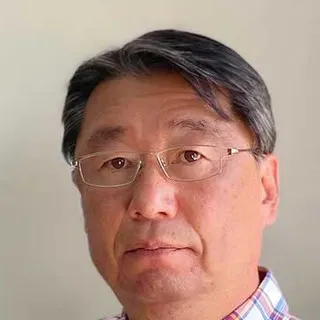 Izu
After university I joined Hewlett-Packard's Japanese company and worked in sales and marketing for things like IT development tools. About 19 years as an ordinary company employee.
But I'd always loved electronics projects, and radio-control models were my hobby. I wanted to build my own original planes and cars. I'd look at other makers' products and think, "I could make something more fun than that." So I quit and, in 2006, started a radio-control model company. That was ENROUTE. We made planes and cars for serious hobbyists. I was one myself, after all.
OgasawaraModels built by a true enthusiast sound pretty serious! So how did you end up with drones?
IzuDrones started flying around 2011. At first they were just an extension of radio control; I'd been flying helicopters for fun too. Drones fly by electronic control, so I got to enjoy both my electronics side and my radio-control side.
Around then, we started working with Tohoku University and others on putting drones to industrial use. Flying out to observe volcanoes, flying them autonomously. It's normal now, but back then hardly anyone was doing it, and that was the exciting part. There was debris-flow research, crop spraying. Surveying from planes or helicopters is a big undertaking, so the thinking was, a drone could make it easy. A lot of the work had to do with disasters.
So we dropped the radio-control business and focused on industrial drones.
OgasawaraYour radio-control fans must have been disappointed.
IzuCustomers let me hear about it, believe me. Some still tell me, "I'm still using one of your old models." But industry just became more interesting to me.
ENROUTE later joined the SKY Perfect JSAT group. The next company I started, EAMS LAB (now EAMS ROBOTICS), was taken over by a company in Fukushima. And in 2018 I started what is now ATTRAC LAB.
No mass production, just development
OgasawaraI understand ATTRAC LAB doesn't mass-produce anything and focuses purely on development. Why go that far?
IzuPut simply, I love development. If you're a manufacturer, you end up carrying everything yourself, from production to customer support. So I built a company that can concentrate on development. Circuit boards or anything else, we outsource the manufacturing. For customer support, we bring in outside help too. We only do the technology development. That's our style.
I work with an engineer in Thailand who handles AI and software and an engineer in the Philippines who handles mechanical design. We've known each other for a long time, and when I said I was starting a company, they joined me.
OgasawaraSo it's a team that spans countries!
IzuThere's a reason for that: we make heavy use of open source. If we built everything ourselves, we'd never have enough hours. Whenever you want to do something, if you look around the world, someone has usually built something similar.
But open source, on GitHub and in community discussions alike, runs mostly in English. Engineers who are comfortable in English fit into that world more easily.
What we do may look a bit cutting-edge in Japan. But by global standards, it's the normal direction. Bringing that to Japanese work sites is our job, I think. Because we're riding global trends, we're unlikely to go badly off course. In Japan, though, we're sometimes a little too early, and it doesn't always land. We put out a lot of press releases this summer, half expecting that many people still wouldn't quite get it.

Teach the craftsman's why, not just the motion
OgasawaraI'd love to hear about the "From skilled workers to robots" announcement in August. This may be a very basic question, but what does it actually mean to teach a robot an expert's skill?
IzuJapan has a lot of accumulated wisdom. Chefs have their techniques, and there are experts who blast rock to dig tunnels. Japanese people are also famously particular about the smallest details, and there's a baseline of common sense: you don't litter, you're on time.
If that were built into AI, it would make Japan more competitive, I think.
Take operating a backhoe, or a robot arm. When an expert operates it, you can record how they moved. But what really matters is why they moved it that way.
A swordsmith looks at the steel and thinks, "it looks like this, so I'll do that." A chef looks at the color of a potato, or something, and decides "it's ready now" and turns off the heat. With camera footage and an AI that reads images (a VLM), a machine can learn the movement. But it can't learn the "why."
OgasawaraIt can learn the movement but not the why... So how do you teach the why?
IzuWhen a master teaches an apprentice, they explain in words: "It was like this, so that's when I turned off the heat."
Large language models (LLMs) have come a long way. So you have the expert talk through what they're doing while they operate, and train on that together with the movement. Then you can raise a robot's brain the way you'd raise an apprentice.
We're building and testing it first on a robot with two arms. "Imitation learning," where a robot learns from human demonstrations, gets this explanation added as a kind of seasoning. That's the gist of the August announcement.
OgasawaraI once saw research from an American university where people demonstrated tasks to a robot dozens of times, and it learned to cook a stir-fry. Is that different?
IzuCooking robots like that are doing something closer to mechanical learning, I think. It's like feeding a robot its steps one by one, or giving a drone a list of waypoints.
That way, it can become a worker, but never a master.
A master is someone who moves with reasons: "if it's like this, I do that." Whether you can build that part of the brain is what matters.
Getting experts to put "it's just a feel" into words
OgasawaraBut if you ask a craftsman "why?", I suspect you'll often hear, "It's just a feel"...
IzuExactly. When I first thought about AI for farming, farmers would say they could tell whether the rice was growing well from its color: "I just get a feel for it." Maybe smell is part of it too.
But these days you can turn all sorts of things into data, and there are measures, like indexes of plant vigor, that see more than the human eye. We're trying to bring a farmer's gut feel into that by having them talk about it. I use farming as the example because it's easy to picture, but our real targets are fields like construction.
What decides it is whether the person can put it into words. So many people work unconsciously. They've just done it that way from experience, without thinking much about it. Their work sits on top of what they were born with and everything they've lived through.
So first we build the human base, a layer of Japanese common sense, like being on time and keeping promises. Then we stack the common sense of the work on top of it. That's what we're trying.
OgasawaraCommon sense first, then the work on top of it. It sounds a bit like raising a child.
IzuIt does. Like raising a child, you learn that if you teach a certain way, you get a certain kind of kid. The difference is that the "child" is a computer, so you can reset and start over.
Whether you give it documents to consult or train it further, it's the same: "that didn't work out, so let's not do that." Today's AI is a lot easier than raising a child, I'd say.
You can even have AI do the teaching. Prepare several "teacher" AIs and see what kind of student each one raises. And with an AI, you can say "no, that's wrong" without holding back. That's a nice part of it.
We also built a way to monitor a robot while it's working. All we did was make the AI's output viewable in a web browser, but now people can see what the robot was thinking when it acted. We develop while checking whether that thinking is what we want.
 Ogasawara
Still, getting experts to explain things well sounds hard too...
IzuWhether the expert gives a good explanation is definitely a factor. If I'm the one teaching, I know a bit about how AI behaves, so I can phrase things to avoid being misunderstood. But some people might crack puns the whole time they're operating.
That's the challenge. There's no established method yet, so we're starting with my own field: drone pilots.
The first student is an "AI pilot" for drones
OgasawaraDrone pilots first, then. What are you teaching?
IzuI've worked with drones for a long time, so I'm teaching it things like what you need to think through in advance before flying autonomously. What we're aiming for right now is putting an "AI pilot" on board a drone.
An uncrewed aircraft has no pilot on board, right? If there were a person on board, they'd notice when things start going wrong: "the vibration's getting worse," or "I'm putting lots of power into this motor, but it's not producing thrust."
Then: do I need to make an emergency landing right now? If I can still fly 500 meters, I'll find an open lot in that range, away from roads, and set down there. That's how a pilot would decide. It can already do about that much.
OgasawaraWait, it can already do that?
IzuNo, that part isn't so hard. We're also making our own flight controllers now (the board that controls how a drone flies). Compare its data with data from normal flight, and you can tell right away when something's off. You can see the IMU (the sensor that measures tilt and shaking) picking up more vibration, in numbers.
Calling it an "AI pilot" is a bit grand, honestly. It's on the level of looking at your car's gauge and deciding, "I'm low on gas, I'd better stop at a station." You could write that as a program. But we hand it to an LLM and let it think it through.
To decide where to land, a long-established type of image AI called segmentation tells open ground, buildings and roads apart. Then we attach a safety factor: roads are dangerous, landing on people is the most dangerous of all. And it lands in the safest spot it can see. We have that control working, more or less.
A beginner pilot could figure this out, and you could do it with plain calculation. But using an LLM for it is, I think, where the real trick of using the brain lies.

Turning a company's manuals into a robot's brain
OgasawaraWhen you say you let an LLM think, do you mean something like connecting ChatGPT to a robot?
IzuWe've built a framework called "AT-SYNAPSE" that does the whole chain: running a local LLM, moving things with words, and so on. We built it in this order: first the brain, and then, as the brain's outlet, you need a robot too.
Once you have a brain, the arms and legs can take many forms. When people use ChatGPT, some ask for recipes and some write math reports, right? But it's the same brain. What matters is what kind of common sense the brain has.
That's why I think a brain specialized for one industry doesn't need to be all that large.
OgasawaraA brain for each industry. How do you build one?
IzuEvery company has work manuals and procedures. A company that does inspections has inspection procedures. Turning those into the brain is something I really want to push forward.
Today, I imagine people find rust or check valve pressure while looking at a manual. In the future, robots and drones will go and look. But you also need a brain that knows how to read the data they bring back. That's where Japan can stand out.
The base model can be something like China's Qwen, or an American one. But the know-how doesn't leave the building. That's why we insist on local LLMs. On top of that, we build the brain.

Starting on construction sites, where AI operates and people watch
OgasawaraWhere do you want to put that brain to use first?
IzuConstruction first, I think. I'd like to say disaster response, but it's hard to get budgets for robots built just for disasters.
Dirty, dangerous, scary work: I think that's going to shift to robots more and more. When it does, it would be good if they had a brain. That's the idea.
I once worked on debris-flow surveys with drones at Mount Unzen-Fugen. That's a site for "unmanned construction," where construction machines are operated with nobody on board. If the lava dome at the top collapses, everyone has to run. So people stayed out of the riverbed and drove the machines while watching video.
Running construction robots where it's dangerous for people to go, and less by remote control than with AI operating and people monitoring. I think that's the level we start from.
OgasawaraAI operates, people watch over it. What would that look like?
IzuThe self-driving that Japan allows for cars today lets you take your hands off the wheel on the expressway, but you still have to keep your eyes on the road. A construction robot would feel similar. For inspections, it might be fully automatic.
When a car turns, there's judgment involved too: at speed you turn the wheel gently, at low speed you turn it a lot. Today's cars use AI to read lanes, but this kind of control is still done with numerical calculation. In the future, I suspect we'll decide it's simpler to make it all AI.
People who write software use AI now and barely code themselves, right? But they still have to say what they want done. It's the same on site: you instruct the AI, and it does the job "the way I always do it." That's actually the direction we're taking with clients.
Let the goal decide the robot's shape
OgasawaraSo you're already moving in that direction with clients. What have you learned from those conversations?
IzuThings move faster with clients who have a clear goal. When technical people talk to each other, they tend to forget the goal and drift into technology talk. With farmers, it's easier when they say, "I don't really understand the tech, just help me grow more rice."
Right now, our "Rail Drone" is being used a lot at a tunnel-digging construction site. At first the client said, "We want to fly a drone." It flies, so it must be able to do anything, right?
But what they actually use is a robot that inspects a 5-kilometer stretch. Going back and forth over 5 kilometers, a drone needs recharging, and flying in a narrow space is risky. So I said, "Why not lay a rail? It saves energy," and they said, "If it does the job, that's fine."
A robot's shape only has to achieve the goal. Yet people sometimes get hung up on the means: we want to use drones, we want to use AI. I sometimes wish they'd settle for something simpler.
OgasawaraWith AI like ChatGPT becoming part of everyday life, conversations like that might get easier.
IzuPeople using ChatGPT on their phones probably have no idea how it works inside. If it answers and explains things nicely, they use it. I think those are the people who'll use robots most naturally, too.
Until now, robots were the domain of specialists. Now it's become easier to bring in the thinking of ordinary craftspeople. That, I think, is the big change LLMs have brought.
Turning rural problems into jobs for robots
OgasawaraLooking ahead, what future do you see for the business?
IzuSince leaving my corporate job and doing this myself, what I've learned is that if you make something useful, people will pay for it. When you build robots and drones, clients say, "This helped, let's keep upgrading it," and they keep finding budget. I think that's the basic rule.
So how do we apply AI technology to the world? I'm in a field right now where robots are running in front of me, and I actually moved out to the countryside to do this kind of work. The countryside has a lot of everyday problems.
Say I want lunch out here. There's no food delivery like in the city. So it'd be nice to have a delivery robot.
Something I see every day: an elderly woman putting her garbage bags on a hand cart and pushing them to the collection point. It's not far, but it's hard work. What if a robot came to her door and carried them to the collection point? Local volunteers could watch from a distance to make sure the robot stops at lights and doesn't do anything dangerous. I think society is heading that way.
 Ogasawara
Robots that support local life. I love that.
IzuWalking and running can be hobbies, for your health. If we leave most of the labor to robots and people can live by using their heads a little, nothing would be better.
When I travel abroad, I notice how clean and safe Japan is. I want to protect that society, and I think that feeling runs deep in Japanese people. But once your body won't move, there's not much you can do, and we already have a caregiving problem. That's exactly where we should put technology to use.
And then, rather than someone writing a program, I hope people can raise their own robots with a feeling of "I'll make my own partner."
OgasawaraRaising your own robot to help you out...!
IzuTake mowing. If you say "mow my yard" and the AI understands what "yard" means, there's no need to program "this area." Say "trim my hedge," and it should do just that. Ask it to wash the car, and it won't wash the neighbor's.
Just as everyone takes cars for granted, a partner that isn't human will be close at hand. Some people in Japan already call ChatGPT by a pet name. "Physical AI" is a buzzword, and maybe few people really get it yet. But if AI can run robots, people will think, "that's handy," and it'll slip into society naturally.
If that future comes, I want to be a maker that supports it.

The body from anywhere, the brain from Japan
OgasawaraSo what ATTRAC LAB is really after is less the robot itself than its brain.
IzuI think that's where Japan can compete right now. Robots overseas have gotten dramatically better in the last few years.
We make a wheel-legged quadruped called "AT-FOX" and a six-legged spider robot. The spider uses Korean actuators (the motors that move the joints), and AT-FOX uses actuators we bought from China. Overseas, lots of startups make parts suited to robots. Buy them, and you can build something similar.
So even if we talk about Japanese manufacturing, it's hard to stand out on the hardware. I think it's the brain.
 Ogasawara
It reminds me of the anime "Ghost in the Shell." The body may be a machine, but if the "ghost" inside is made in Japan, you'd want to use it.
IzuIt does, doesn't it? Anime and entertainment think things through, too. We're not in that world yet, but they've already worked out in detail what would be dangerous.
While Japan still has an image as a good country, one with common sense, a clean country, I want to deliver Japan's brains to the world.
OgasawaraYou also hear a lot that Japan has fallen behind in robotics...
IzuPeople say Japan is behind because it can't build robots like those. I think that's a bit off.
Boeing, for example, builds its planes with carbon fiber from Japan's Toray. The parts can come from anywhere, I think. In the end, Boeing, which delivers the solution of carrying passengers, is the one that makes the money.
So if the good parts are overseas, use them freely and say, "We build robots with great brains." If someone asks where Japan can compete, I think that's where.

Happy to be the one who gets the ball rolling
OgasawaraWill you take that "brain" overseas as well?
IzuSaitama Prefecture is very keen to help companies expand abroad, and next month I'll be taking part in a startup event in Singapore. I plan to give a pitch along the lines of what we talked about today. I'm thinking of pitching it as, "Want to buy a Japanese brain?"
That said, neither the value of a brain nor how to build one through imitation learning is firmly established yet. I want us to be the ones who show that if you build it this way, it gets smart.
OgasawaraFrom Japan to the world. Listening to you, I'm getting excited!
IzuBut we really are a behind-the-scenes company, the kind that offers hints. The one who gets the ball rolling. I'd like Japan's core companies to pick up these ideas and take them global. We're not going to conquer the world ourselves. If Japanese industry and the Japanese economy do well, my own life should get better too.
Big companies often move only once they know there's money in it. So if a venture like ours starts doing something exciting, the big players might jump in. That's the kind of momentum I want to create.
The cheaper robots get, the more a craftsman's "why" is worth
After the interview, I set Izu's word "brain" side by side with data and ideas from other fields. It looked like a story about robots, but underneath it was the value of the unspoken know-how sitting on Japan's work sites.
Tacit knowledge: the homework Japanese management scholars named 30 years ago
Izu kept coming back to "whether you can put it into words." That problem has had a name for a long time: tacit knowledge.
In his 1966 book The Tacit Dimension, the Hungarian-born philosopher of science Michael Polanyi used "tacit knowledge" for what we understand through our bodies and experience but can't put into words, writing that "we can know more than we can tell." In the 1990s, two Japanese management scholars, Ikujiro Nonaka and Hirotaka Takeuchi, turned the idea into a model for how companies work in The Knowledge-Creating Company. Turning tacit knowledge into words and diagrams that others can share was a stage they called "externalization."
But externalization has always been expensive. Someone sits next to a veteran, listens, and writes it all up as a manual. It takes effort and time. Among Japanese manufacturers, only 21.7% use digital technology to pass on skills.
Izu's approach changes that. The expert just talks while working. Transcribing the words and linking them to movement and video is the AI's job. LLMs have made it cheap to tackle the homework Japanese management scholars named 30 years ago. That's how I read it.
The body got 3 times faster in a year. Time is running out for the words
The winning time in the humanoid half marathon went from 2 hours 40 minutes to 50 minutes in one year. With money and parts, bodies can evolve that fast. And as Izu says, good parts are available all over the world.
An expert's words, on the other hand, can't be multiplied with money. Japan's skilled construction workers fell from 4.55 million in 1997 to 3 million in 2024, and 25.8% of them are 60 or older.
At one point in the interview, Izu said experts' brains should be captured "while they're still working." He said it in passing, but it's the heaviest line of all. Robot bodies can catch up next year. But once today's veterans leave the job, there's no going back to ask them their "why." The cheaper robots get, the more the words you saved in time are worth. That's the race we're in.
Japan's winning position is assembling trust in the finished product, not making the parts
Later in the interview, when I raised the claim that Japan has fallen behind in robotics, Izu answered that the parts can come from any country. The example he gave was aircraft. Looking into it, I found that Boeing's 787 uses Toray's carbon fiber materials in critical parts of the airframe such as the wings and fuselage. Japan was on the side making excellent parts. But it's Boeing, which assembles the plane and takes responsibility for flying it safely, that gets paid for carrying passengers.
Izu's proposal is to swap those positions for robots. Buy the parts from the world. Japan takes on the role of assembling a brain with on-site common sense and the systems that run it safely.
Look at ATTRAC LAB's design, and that "common sense" is already in the spec. Safety-critical control isn't left to AI. When in doubt, ask a person. Know-how stays in-house, trained on local LLMs. And robots weaker than people. If an era comes when robots are chosen for the trustworthiness inside them, that's probably why Japanese brains will sell.
What to watch from here depends on where you stand.
- If your company runs work sites
Alongside the veterans' manuals, start recording their verbal habits and the reasons behind their decisions, as audio or text. That becomes the raw material for a robot's brain. - If you're an engineer or researcher
ROS 2, ArduPilot, LLMs that run locally: most of the tools ATTRAC LAB uses are available as open source. Everything you need to try this on a small scale is already there. - If you're a student
Teaching AI a job, watching over AI's decisions: new roles like these are starting to appear even in the world of skilled trades.
From a race to build robot bodies to a race to teach robots the "why." That's the view I most wanted to bring home from this interview.
Make Japan's "brains" an export industry
Can you teach a robot a craftsman's gut feel? Izu's answer to the question I brought into the interview was far more concrete than I expected. Movements can be recorded, so you add the "why" behind them, in the expert's own words. The first student is a drone's AI pilot; next come construction sites.
Beyond that, Izu is looking at life in the countryside. A robot that helps an elderly neighbor take out the garbage. A mower that works when you say "mow my yard." A society where, instead of someone writing a program, each of us can say, "I'll make my own partner."
At the end of the interview, Izu wrapped up like this: "Let's go as far as making Japanese brains an export industry."
I've asked him to show us next time, on site, how the robots are growing up. When he does, I plan to peek at "the robot's thoughts" on the AI monitor too.
SOURCES ── References
- ATTRAC LAB, Message from the CEO and company profile (in Japanese)
- ATTRAC LAB, Products (in Japanese)
- ATTRAC LAB, From skilled workers to robots: development begins on skill-transfer robot technology using imitation learning (PR TIMES, August 20, 2026) (in Japanese)
- ATTRAC LAB, AT-SYNAPSE, an autonomous control system that uses ChatGPT, Claude and Gemini as a robot's brain (PR TIMES, July 23, 2026) (in Japanese)
- ATTRAC LAB, AT-SYNAPSE Web Console visualizes an AI robot's "thinking" (PR TIMES, July 24, 2026) (in Japanese)
- ATTRAC LAB, "Safety-critical control does not depend on AI": the safety design of AT-ROS behind AT-SYNAPSE (PR TIMES, August 13, 2026) (in Japanese)
- ATTRAC LAB, Local LLM/VLM environment for AT-SYNAPSE on NVIDIA DGX Spark (PR TIMES, August 14, 2026) (in Japanese)
- ATTRAC LAB, Toward "AI that knows the site": an on-site learning service using multimodal RAG (PR TIMES, August 20, 2026) (in Japanese)
- ATTRAC LAB, AT-GCS, a web ground station that controls land, surface, underwater and aerial robots together (PR TIMES, August 18, 2026) (in Japanese)
- ATTRAC LAB, A catamaran with 3D LiDAR that navigates underground waterways without GNSS (PR TIMES, July 22, 2026) (in Japanese)
- ATTRAC LAB, Fukushima Prefecture grant for a Japan-made AI flight controller (PR TIMES, July 22, 2026) (in Japanese)
- ATTRAC LAB, AT_FC01, a Japan-made flight controller that makes ArduPilot more accessible (PR TIMES, July 23, 2026) (in Japanese)
- ATTRAC LAB, A lightweight, easy-to-repair drone made of cellulose fiber (PR TIMES, July 21, 2026) (in Japanese)
- ATTRAC LAB, Rail Drone, a rail-running AI monitoring robot in place of drones (PR TIMES, July 22, 2026) (in Japanese)
- ATTRAC LAB, A six-legged spider robot that crosses rubble and "judges by touch" (PR TIMES, July 23, 2026) (in Japanese)
- ATTRAC LAB, AT-FOX, a field robot combining wheels and legs (PR TIMES, July 24, 2026) (in Japanese)
- ATTRAC LAB press releases (PR TIMES) (in Japanese)
- ATTRAC LAB official YouTube, An LLM robot that runs on natural language alone (in Japanese)
- ATTRAC LAB official YouTube, Rail Drone for remote monitoring of construction sites (in Japanese)
- ASCII.jp, ENROUTE's Izu, who turned a love of radio control into a drone maker (August 8, 2016) (in Japanese)
- DRONE.jp, ENROUTE joins the SKY Perfect JSAT group to expand its drone business (July 1, 2016) (in Japanese)
- DRONE.jp, The new EAMS LAB shows a range of distinctive drones at Japan Drone 2018 (March 23, 2018) (in Japanese)
- MONOist, Field test of debris-flow prediction using multirotor drones (December 12, 2016) (in Japanese)
- Smithsonian Magazine, A Humanoid Robot Just Beat the Human World Record for the Fastest Half Marathon During a Race in China (April 22, 2026)
- MLIT, Data on workers and skilled workers in construction (January 27, 2026) (in Japanese)
- Japan Institute for Labour Policy and Training, Survey on securing and retaining workers and passing on skills in manufacturing (May 27, 2026) (in Japanese)
- MLIT, i-Construction 2.0 (April 2024) (in Japanese)
- MLIT, Aging infrastructure: current state and outlook (in Japanese)
- MLIT Kyushu Regional Development Bureau, Unmanned construction training to be held again this year (September 25, 2019) (in Japanese)
- Fu, Zhao, Finn, Mobile ALOHA: Learning Bimanual Mobile Manipulation with Low-Cost Whole-Body Teleoperation (arXiv, January 2024)
- Google DeepMind, Gemini Robotics 2 brings whole-body intelligence to robots (July 30, 2026)
- Ross, Gordon, Bagnell, A Reduction of Imitation Learning and Structured Prediction to No-Regret Online Learning (AISTATS 2011)
- Michael Polanyi, The Tacit Dimension (1966, CiNii Books)
- Ikujiro Nonaka and Hirotaka Takeuchi, The Knowledge-Creating Company (CiNii Books)
- Boeing, Boeing Names Toray Industries, Inc., to 7E7 Team (May 26, 2004)


