An AI wrote 719 math papers in two weeks. Did OpenAI just solve the Riemann hypothesis? We counted all 372 results
OpenAI has released 719 math papers written by an unreleased internal AI model, headlined by a claimed proof of the "quasi-Riemann hypothesis." So has the 160-year-old Riemann hypothesis finally fallen? No, though the claim could be a big step toward it. We recounted all 372 results ourselves: 36% have a main result checked by computer, about one in five overturns a conjecture, and the manuscripts run to more than 34,000 pages.
 DATA WORLD Editorial Team
Feature · 12 min
DATA WORLD Editorial Team
Feature · 12 min

Mathematics has problems that have resisted everyone for more than a century. The most famous is the Riemann hypothesis, a conjecture about the hidden order of the prime numbers, with a $1 million prize for whoever settles it.
On October 6, 2026, OpenAI released 719 math papers in one go, including work around that very problem. They were written by an AI model the company has not yet released. The headline paper claims a proof of the "quasi-Riemann hypothesis," and social media quickly filled up with people asking whether the Riemann hypothesis had finally been solved.
Just last week, we wrote about how the preprint server arXiv began capping submitters at two new papers a month because of a flood of submissions. Now an AI drops 719 papers at once. My honest first reaction was: who is going to read all this?
So we went through the published catalog and data and counted everything ourselves. Here's the short version.
- The Riemann hypothesis has not been solved
What OpenAI claims to have proved is the "quasi-Riemann hypothesis," a step short of it. The paper itself says the Riemann hypothesis remains open. - If it holds up, it's a big step
The claim is that the zeta function has no "zeros" to the right of real part 7/8. No one had managed to prove anything of that kind before. - Only part of it has been checked
Computers have verified the main result for 36% of the 372 results. Three manuscripts were withdrawn the day after release.
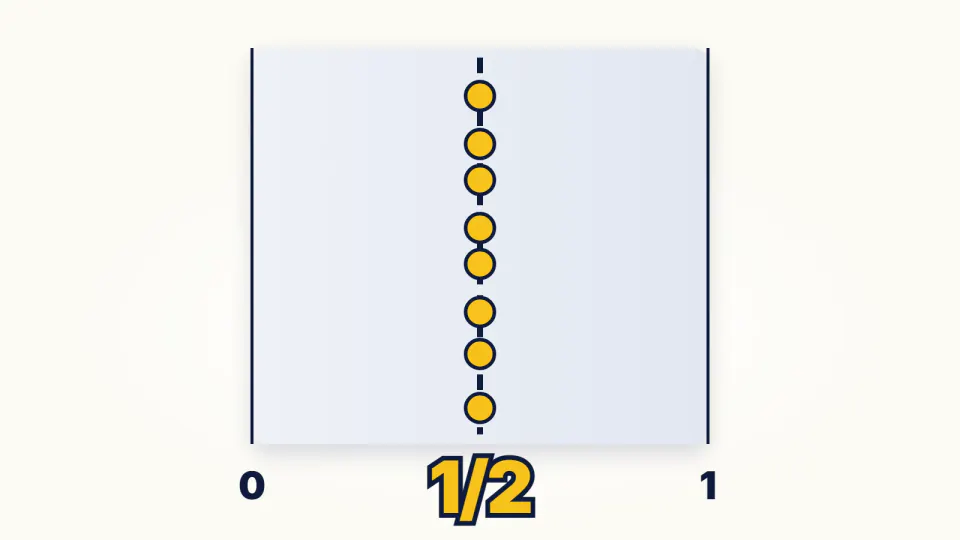
Riemann hypothesis
The claim that every important zero of the zeta function lies on a single line at 1/2. It governs how the primes are spread out, and it is one of math's biggest open problems
- 1859Riemann's conjectureLinks counting primes to where the zeta function equals zero
- 1896Prime number theoremShows there are no zeros on the line at real part 1
- 2000A $1 million problemNamed one of the Clay Institute's seven Millennium Prize Problems
- 2021Checked to height 3 trillionEvery zero computers have checked sits on the line
- NOWOpenAI claims 7/8Says it has pushed back the zone where zeros cannot exist
The Riemann hypothesis is one of the seven Millennium Prize Problems the Clay Mathematics Institute selected in 2000. What's at stake is how precisely we can predict how often prime numbers turn up.
Computers have already checked an enormous number of zeros. In 2021, researchers confirmed that every zero up to a height of 3 trillion lies on the predicted line. But nobody has proved it for all of the infinitely many zeros.
Four questions about OpenAI's 719 math papers, answered up front
The Riemann hypothesis is still open. OpenAI claims a step toward it, and the checking has only just begun
Q1Is the Riemann hypothesis solved?
Q2What does 7/8 mean?
Q3How certain is it?
Q4What do mathematicians think?
34,000 pages written by an AI in two weeks
OpenAI posted the manuscripts on GitHub. There were 722 at release. Three were withdrawn the next day, leaving 719. Grouping related manuscripts into "results" gives 372. Almost all of them come from the company's unreleased internal model.
According to OpenAI, the model was given about 4,000 problems. Each result took, on average, three hours' worth of ChatGPT Pro thinking compute. Out of those 4,000 problems, 372 were judged significant enough to publish.
We also measured the sheer volume. Adding up the PDFs gives about 34,600 pages. The average manuscript runs 48 pages, and the longest is 262. A specialist reading 50 pages a day would need almost two years to get through them all.
And look at the dates. 99% of the 719 manuscripts are dated between September 23 and October 7. Papers of a length that would take a human mathematician months each were produced, in bulk, in about two weeks.
What OpenAI claims is the quasi-Riemann hypothesis
First, the question everyone is asking. The Riemann hypothesis has not been solved.
That isn't our judgment. It's what OpenAI's own paper says. In its introduction, the quasi-Riemann paper states plainly that its theorem does not establish the Riemann hypothesis, which remains open.
So what does it claim? Here's the idea, with as little math as possible.
Think of the zeta function as a map
The star of the Riemann hypothesis is the zeta function. You can picture it as a map of a flat plane, with a value attached to every point. The points where the value is zero are called "zeros."
A point's horizontal position is called its "real part." The important zeros only ever appear in a vertical strip between real part 0 and real part 1. The Riemann hypothesis says they all line up exactly down the middle of that strip, at real part 1/2.
Why does that matter? The farther the zeros stray to the right of the middle line, the bigger the error in counting prime numbers. If the Riemann hypothesis is true, we can predict how many primes there are up to any point with a very small error.
Until now, only a sliver near the edge
The prime number theorem, proved in 1896, showed there are no zeros on the right edge of the strip, at real part 1. Later work showed there are none just inside that edge either.
But that zero-free zone gets thinner the higher up the map you go. Far up, a zero could in principle sit arbitrarily close to the edge. No one had ever drawn a straight line and proved there are no zeros at all to its right. Whether such a line can be drawn is the quasi-Riemann hypothesis.

OpenAI's paper claims that the zeta function has no zeros with real part greater than 7/8. In other words, it draws a straight line at 7/8 that doesn't narrow as you go up. It claims the same for the zeta function's relatives, the Dirichlet L-functions.
Two numbers, 7/8 and 11/12, circulated online and caused some confusion. The manuscript explains why. The 199-page paper has two parts: the first proves the line can be drawn at 11/12, and the second pushes it to 7/8. So 11/12 is a stepping stone on the way.
How big a deal would it be? Applied mathematician John D. Cook worked out on his blog how much tighter the error in counting primes would become, a clear improvement on existing bounds. Hector Pasten, a mathematician at the Pontifical Catholic University of Chile, told Scientific American the quasi-Riemann hypothesis is more than enough for many applications.
Still, a wide gap remains between 7/8 and 1/2. The distance left to the Riemann hypothesis is everything from 7/8 down to 1/2, and this paper doesn't yet show a path across it.
All 372 results counted: one in five overturns a conjecture
The quasi-Riemann result is just one of 372. To see what else is in there, we went through the entire catalog.
The results span 17 fields. The biggest by count is theoretical computer science, which studies how fast and how hard computations are, with 40 results. Next come combinatorics (37), algebraic and complex geometry (36) and number theory (31). By number of manuscripts, probability and statistical mechanics leads with 105, with long chains of papers behind single results.
Plenty of famous problems appear on the list:
- Pi's "irrationality exponent" is exactly 2
This number measures how well pi can be approximated by fractions, and the claim pins it at 2. INTEGERS, a Japanese number theorist's blog, notes the previous upper bound was about 7.1 and calls it the result that moved the author most. - Faster matrix multiplication
Matrix multiplication sits at the heart of AI computing. The claim lowers its exponent from about 2.37 to 9/4 (2.25). - Hilbert's tenth problem over the rationals
The claim is that no general procedure can decide whether an equation has a solution in fractions.
Another striking group: results that overturn conjectures. Counting results whose descriptions begin with "Disproves," "Refutes" or "Constructs," or whose titles include "counterexample," 70 of the 372, or about one in five, answer "that conjecture is false." One of them claims a counterexample to Hadwiger's conjecture, a famous problem about coloring graphs.
And 205 of the 372 results (55%) consist of a single manuscript. The rest are built from 2 to 14 manuscripts each, with bigger results stacking up supporting lemmas and alternative proofs.

36% checked by computer
Who is going to check this many proofs? OpenAI is leaning on a tool called Lean.
For the quasi-Riemann result, the statement to be proved takes just two lines of Lean: if the real part of a complex number s is greater than 7/8, the zeta function at s is not zero. Any mathematician can read those two lines and see what they say. The question is whether the computer accepts the long proof behind them. Humans check the short statement; the computer checks the long proof.
Not every result works that way, though. Counting results with a main-result formalization listed in the Lean catalog, we get 135 of 372, or 36%. OpenAI says about 42% of top-line results are formalized, but that figure is 300 divided by the 719 manuscripts, so both the numerator and the denominator differ from ours.
Broken down by field, the gap is stark.

Mathematical logic has 5 of 6 and functional analysis 8 of 11. Topology, which studies how shapes connect, has 1 of 18, and algebraic geometry 7 of 36. Fields where Lean's library already has the right tools may simply be easier to check. Either way, the numbers show that how easily a computer can check a result varies enormously from field to field.
The remaining two-thirds or so can only be checked by people reading them, and errors have already surfaced. The day after release, OpenAI withdrew three manuscripts: a sign error in one paper on the Hodge conjecture also broke two papers that relied on it. The same day, it repaired proofs in 14 others. None of the three withdrawn papers appeared in the Lean catalog on release day; none had been checked by computer.
Lean has limits too. The computer only checks the statement as written in Lean. Whether that matches the claim in the paper's prose is something only a person can judge. Mathematicians at the University of Cambridge and King's College London reported at least two discrepancies between the prose and the Lean code in OpenAI's earlier Navier–Stokes result. And OpenAI's own Lean catalog still lists its human review status as “unchecked”.
Mathematicians are split between praise and alarm
Reactions from mathematicians are sharply divided.
First, the praise. Pasten called the approach in the Hilbert's tenth problem result “original”. Daniel Litt of the University of Toronto told Fortune “this is great for mathematics,” though he worries that a perception that AI has "solved math" could cut research funding.
The criticism is just as strong. Fields medalist Terence Tao of UCLA said the people prompting the AI don't understand the output well enough to answer questions about it. Harvard's Melanie Wood said that at release there is no human understanding of the results yet, and that the real work starts after.
A group called the Association for Human Mathematics (AHM) issued a statement saying mathematicians did not ask for this work, going as far as to call the 700-plus files "a demonstration of power" rather than scholarship.
Much of the criticism targets how the results were released, not whether they're correct. The advisory group at the Institute for Advanced Study, which OpenAI consulted, recommended in late September that labs disclose the model name, prompts and compute costs. In this release, reasoning summaries were published for only 10 results. The group says it is up to the mathematical community to judge whether its recommendations were followed.

What's running short isn't the power to solve. It's the power to verify
After counting all 372 results, the question I was left with wasn't about the Riemann hypothesis. It was closer to home.
Who is going to read 34,000 pages?
The AI wrote 34,000 pages in two weeks. It would take human experts years to read them all. arXiv capped submissions for the same reason: there wasn't enough reading time to go around.
The gap between how fast we can write and how fast we can read and verify has never been wider. The three withdrawals the next day were that gap showing through. What research will run short of isn't the ability to produce answers. It's the human time to check and understand them.
Two lines of statement, one machine-checked proof
There's hope here too. Boil the claim down to two lines, as with the quasi-Riemann result, and let a computer check the long proof. Then a person only has to read two lines to decide whether to trust the result.
That lesson reaches well beyond math. When we hand AI a program or a report to write, we also need to decide up front what we'd check to trust the result. When you give AI a job, design how you'll verify the answer at the same time. Those two lines of Lean looked to me like the cleanest example of that yet.
SOURCES ── References
- OpenAI, Sharing AI progress in mathematics (October 6, 2026)
- OpenAI, openai/math GitHub repository (README, CONTENTS.md, history.md, lean/formalization.yaml; counted as of the October 8, 2026 version)
- OpenAI, history.md (withdrawals and fixes on October 7, 2026)
- OpenAI, The Quasi-Riemann Hypothesis: A Zero-Free Half-Plane Re(s)>7/8 (manuscript dated September 30, 2026)
- OpenAI, The quasi-Riemann hypothesis (scope of the Lean formalization)
- OpenAI, QuasiRiemannHypothesis.lean (the statement checked by Comparator)
- Scientific American, The most exciting claims from OpenAI's heap of new proofs (October 8, 2026)
- Fortune, OpenAI publishes solutions to more than 370 outstanding math challenges. Math may never be the same (October 7, 2026)
- TechCrunch, OpenAI's math solutions aren't meeting the field's standards yet (October 8, 2026)
- Association for Human Mathematics, AHM Statement on OpenAI's October 6 Release of Mathematical Documents (posted on Terence Tao's blog, October 7, 2026)
- INTEGERS, The results that surprised me most in OpenAI's October 7 release (October 7, 2026) (in Japanese)
- John D. Cook, Consequences of progress toward the Riemann Hypothesis (October 7, 2026)
- Clay Mathematics Institute, Riemann Hypothesis (Millennium Prize Problems)
- Platt & Trudgian, The Riemann hypothesis is true up to 3·10^12 (Bulletin of the London Mathematical Society, 2021)


